Product
From my workflow to a repeatable one
Compass was built around my search. Ponchos starts with each person's role, environment, category, stage, buyer, and sales-motion preferences, then ranks the market around them.
How a research tool I built for my own job search became Ponchos, a career intelligence product that helps salespeople decide which companies are worth pursuing and why.
I had spent years qualifying complex enterprise deals, but I did not have a good system for choosing where I wanted to work next.
That choice can shape your earnings, equity, reputation, and career. But the useful information is scattered across investor portfolios, company sites, job postings, funding announcements, developer communities, and personal networks.
I ran into this while planning my own return to the startup world. I was looking for technically ambitious companies, generally around Series A through C, with strong product, funding, hiring, and developer momentum. Finding open roles was easy. Deciding which companies deserved my attention was not.
Compass began with a Python script and a Google Sheet. The script found companies; the sheet immediately became another undifferentiated list. So I moved the data into a database and built a research system around a more useful question: which companies fit my career thesis right now, and what evidence supports that conclusion?
The prototype separated shared company facts from personal preferences. It researched funding, hiring, developer activity, and market context, then combined those signals in Radar, a ranked target list that kept the evidence visible.
Compass was intentionally built for one user: me. That constraint was useful. It let me test the underlying research model against a real decision before trying to turn it into a broader product.
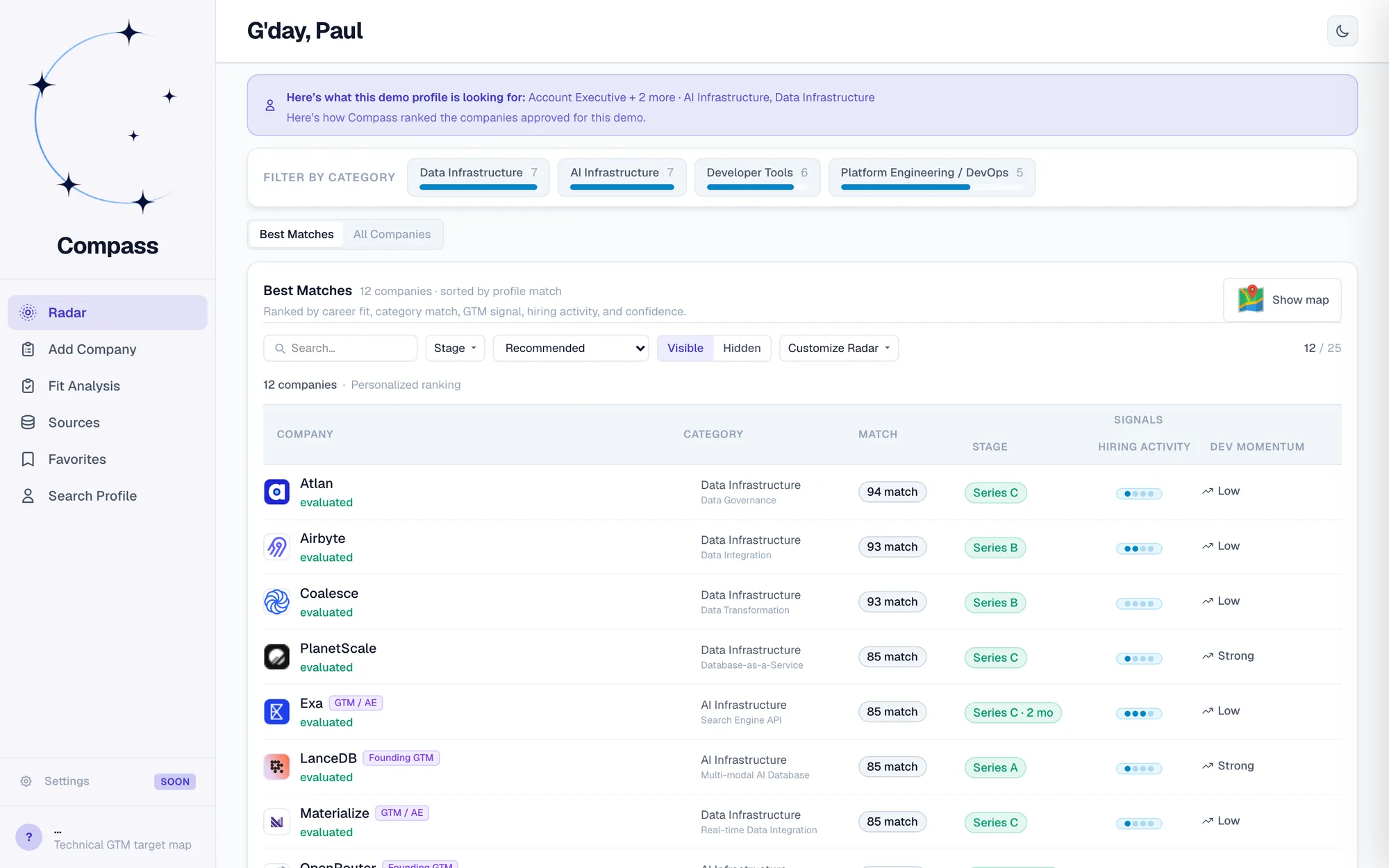
Compass was built around my search. Ponchos starts with each person's role, environment, category, stage, buyer, and sales-motion preferences, then ranks the market around them.
The value is not another place to browse jobs. It is better diligence before a seller invests time, reputation, and earning potential in a company.
Compass put most of the system on screen. Ponchos starts with the decision, guides people through their Search Profile, and reveals the evidence as they explore each company.
Ponchos takes a scattered company landscape and narrows it to a shortlist worth a closer look.
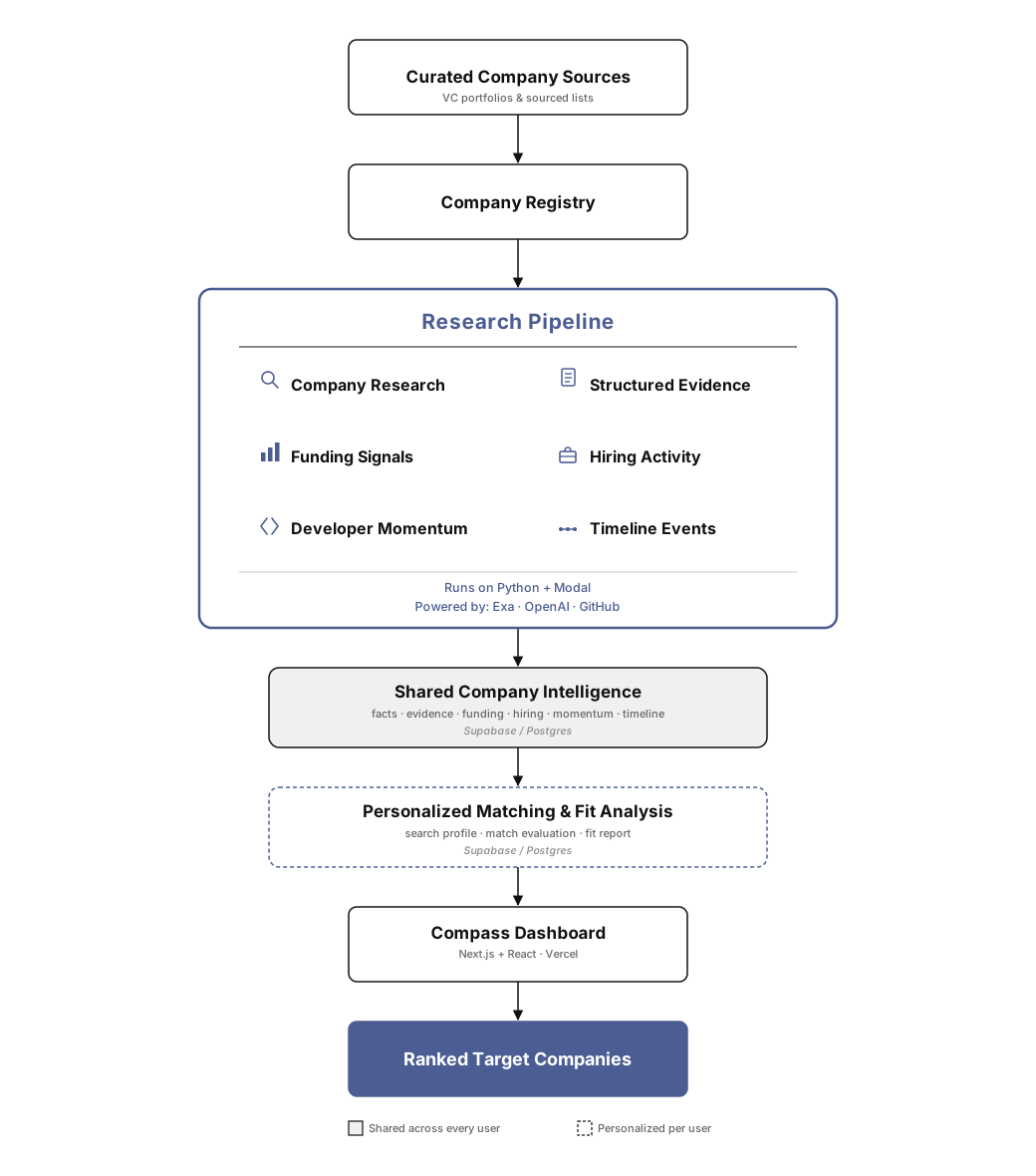
The system combines a maintained company universe with structured research, then applies the user's Search Profile when it ranks the results. That keeps the underlying company intelligence reusable while making the shortlist personal.
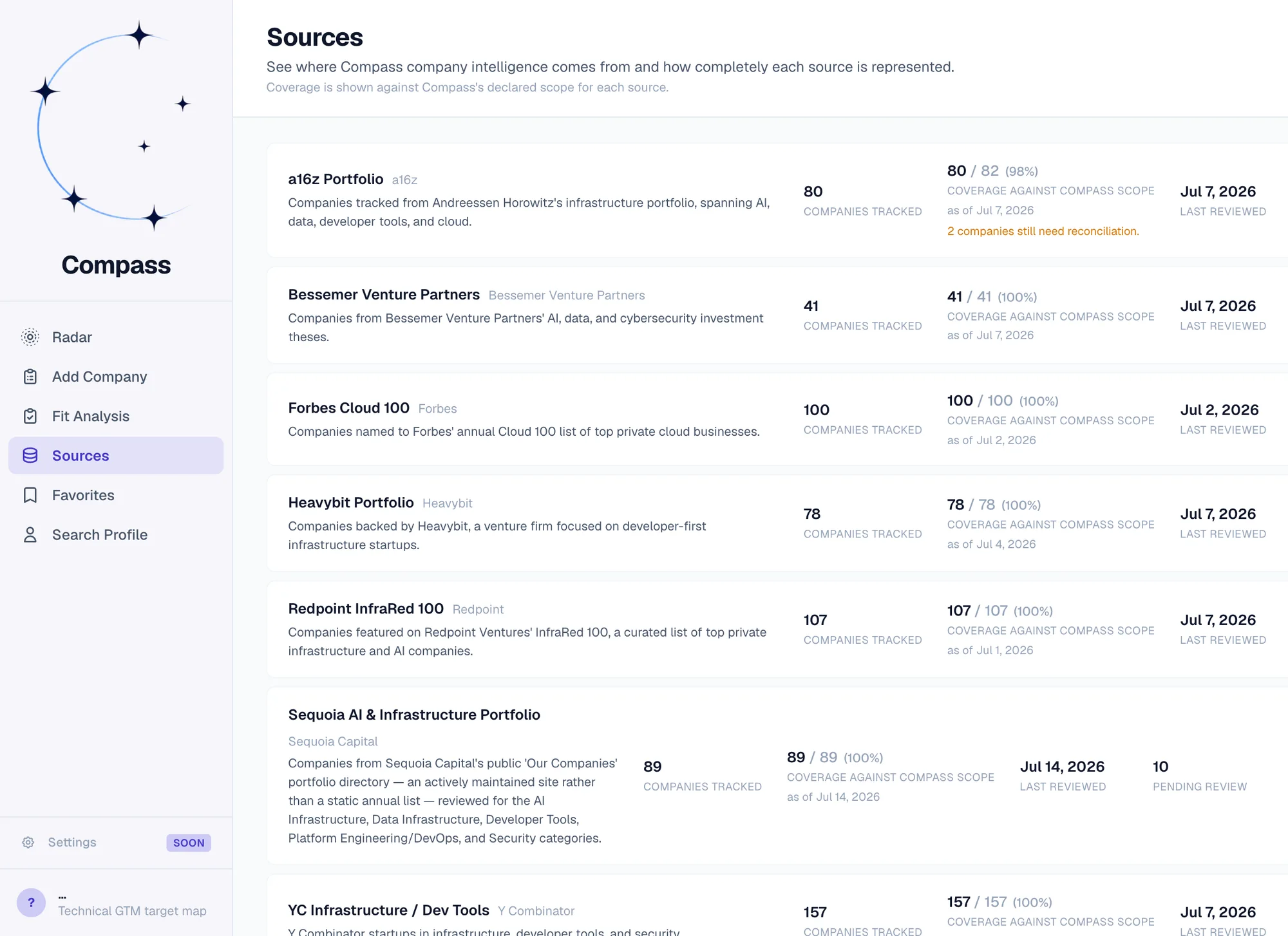
Curated investor portfolios and industry lists create a company universe with a clear source behind every entry.
Focused modules evaluate company facts, funding progression, hiring activity, developer momentum, and market context.
A Search Profile captures how someone wants to sell: role, stage, categories, buyers, environment, and motion.
Radar brings the strongest matches forward while keeping the underlying signals available for inspection.
No single metric can tell you whether a company is a good career bet. A recent funding round means something different when you look at it alongside technical hiring, developer adoption, and the company's go-to-market motion.
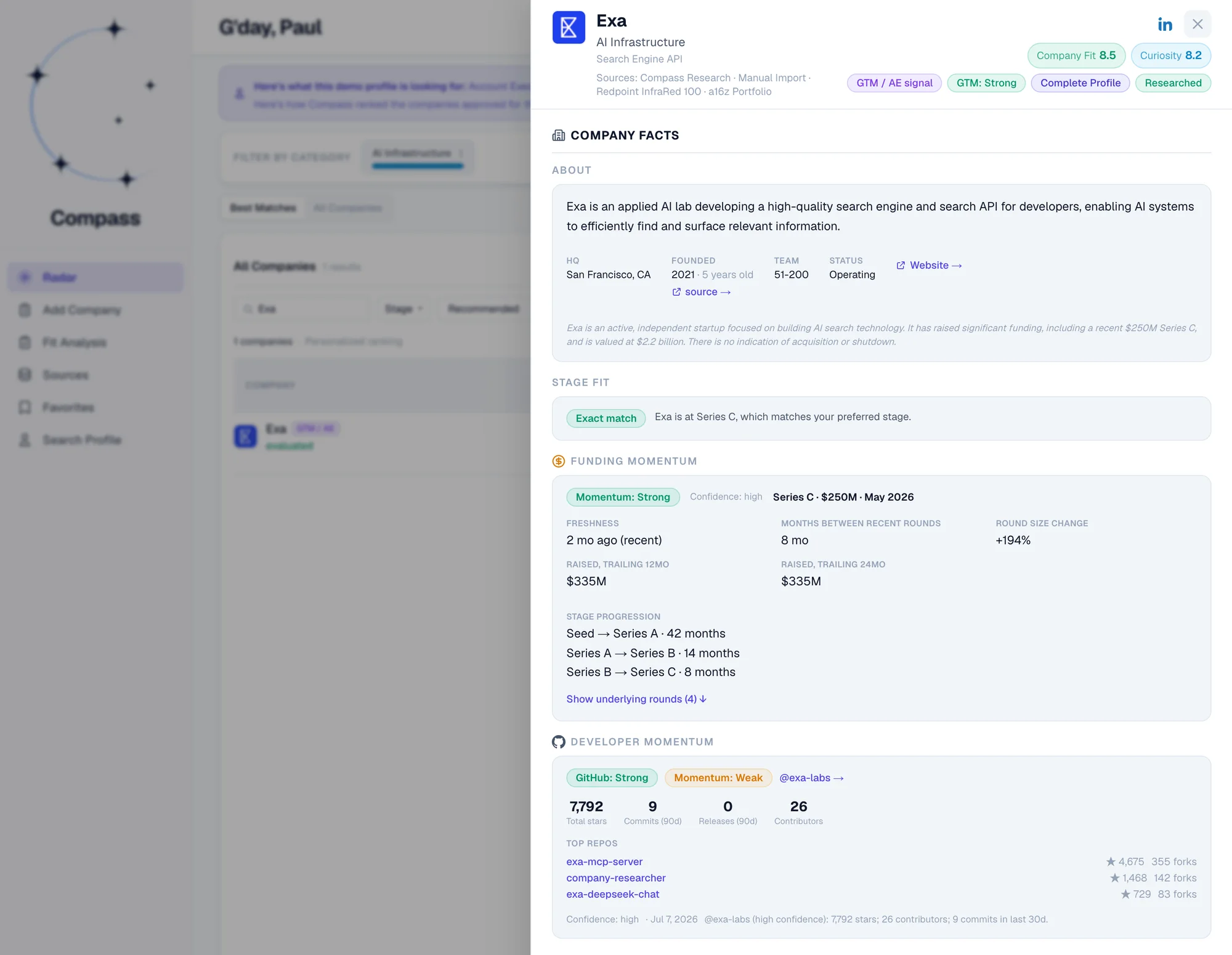
So Ponchos looks at the signals together without hiding them behind one opaque number. A ranking is a reason to investigate, not an answer to accept. Company profiles bring the facts, sources, and open questions together so the user can make the final call.
The biggest design change was not visual. I had to make the judgment I was doing in my head understandable to someone else.
Compass could assume the user already understood the categories, scoring logic, and research workflow because I had built them for myself. Ponchos could not. It needed to explain what each signal meant, show how a person's preferences changed the ranking, and provide a useful starting point without making them learn the whole system first.
That led to a guided Search Profile, clearer fit language, a market view for discovery, and company profiles that connect product, buyers, sales motion, funding, hiring, and developer activity. The interface now answers two questions: why should I look here? and what should I verify next?
I designed and built Compass and Ponchos end to end. That included the product direction, positioning, interaction design, data model, research workflows, application architecture, QA, and deployment. I used modern AI development tools to move faster, while keeping the product decisions and technical judgment my own.
The application separates the customer experience from research execution. Structured company data and user-specific fit stay distinct, long-running research operates independently from the interactive product, and public-facing experiences are isolated from private account data.
The hardest decisions were about the product itself: which evidence is actually useful, where confidence should be visible, what belongs in a ranking versus a company profile, and how much complexity to show at once.
Compass changed my own search from reactive browsing into deliberate research. It also showed me that the problem was bigger than my job search. Salespeople already understand diligence and risk. We just do not always apply that same discipline to our own careers.
Ponchos is the current version of that idea. It works for more than my preferences, explains the value in the user's language, and treats the choice of company with the weight it deserves.
Compass is still part of the story. It was the working prototype that established the research model, showed me what did not scale beyond one user, and made Ponchos possible.